
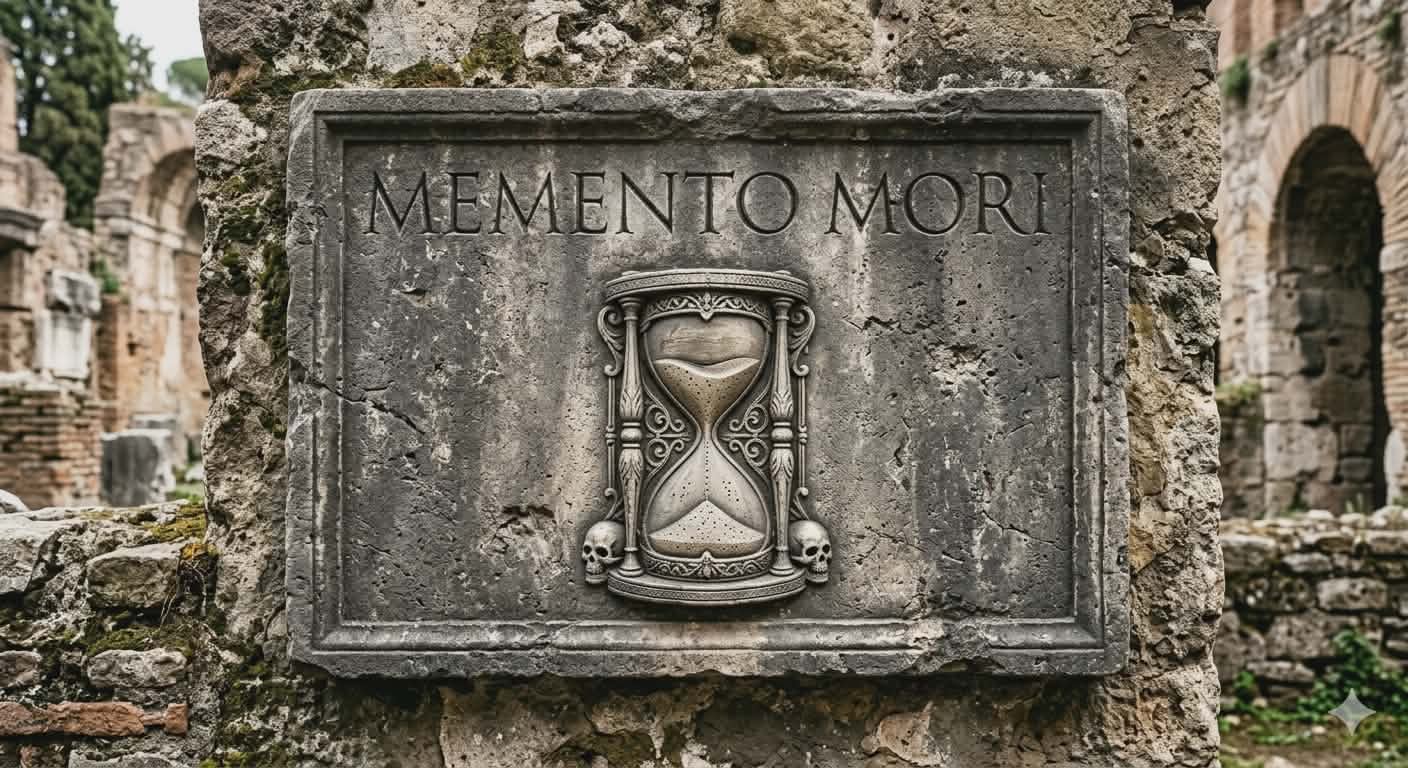
December 2025, I began my 60th year of my journey upon this great planet we call earth – the home of the most unique creation of the Creator of heaven and earth.
Looking back over my life, I examined and meditated on the years that are now gone, and I seem to have noticed a pattern that can only be seen from the rearview mirror. That is, with every new decade of life, there seemed to be some sort of new change destined to make life-altering changes to the journey I am on; my 60th year was to be no different.
Shortly after stepping into my 60th year I was involved in an unpleasant event at work. January had just arrived and an altercation with a coworker came out of nowhere. A coworker had gone to other coworkers behind my back about something they did not like about me instead of coming to me directly, face-to- face. When the altercation was over, I knew that I was correct in my response to this person about the wrong that they had done, but I was wrong in how I reacted to the situation.
This troubled my soul. This event would be the one that caused me to seek for a system or program that I could learn to bring discipline to my character, my being. My search guided me to discovery the philosophy of Stoicism – a philosophy for self-discipline.
By the middle of January, I began learning from the great Stoics masters of the ancient past, Zeno of Citium, Seneca, Epictetus, and Marcus Aurelius.
To my surprise, I have found that the majority of what I am learning about Stoic self-discipline aligns fully with my biblical/Torah worldview as a ben Noach (son of Noah).
Memento Mori
Memento Mori is one of the foundational Stoic meditations, its purpose is to helps us comprehend the reality, that life is short and that even one passed second of time is a form of death.
In this essay, we will examine Memento Mori in the context of the wisdom of the ancient Greeks, Romans, and the Hebrew Scriptures, and the teachers of the Torah.
Memento Mori is Latin and translates to “Remember death”
Memento Mori as a principle means “Remember you must die”
From the ancient Stoic Masters:
Marcus Aurelius:
You could leave life right now. Let that determine what you do, say and think.
Not to live as if you had endless years ahead of you. Death overshadows you. While you’re alive and able – be good.
Think of yourself as dead. You have lived your life. Now, take what’s left and live it properly.
Don’t look down on death, but welcome it. It too is one of the things required by nature.
Seneca:
The final hour when we cease to exist does not itself bring death; it merely of itself completes the death-process. We reach death at that moment, but we have been a long time on the way.
This is our big mistake: to think we look forward to death. Most of death is already gone. Whatever time has passed is owned by death.
He who has learned to die has unlearned slavery.
We do not suddenly fall on death, but advance towards it by slight degrees; we die every day.
Epictetus:
We suffer not from events themselves but from the opinions we form about them. Death, he argued, is not evil — it’s simply part of nature’s order.
Keep death and exile before your eyes each day, along with everything that seems terrible—by doing so, you’ll never have a base thought nor will you have excessive desire.
Do not act as if you were going to live ten thousand years. Death hangs over you. While you live, while it is in your power, be good
From the Hebrew Scriptures and the Masters of Torah:
Rabbi Samson Raphael Hirsch:
The Hirsch Chumash, Genesis 2:17 “On the day you eat from it, you must die, apparently means: you will be liable to death. For the truth is that they did not die on that day; rather, they were given the commandment to death.”
King Solomon
It is better to go to the house of mourning than to go to the house of feasting, for that is the end of all men, and all the living should take it to heart. Grief is better than gaiety – for through a sad countenance the heart is improved. The thoughts of the wise turn to the house of mourning ,but the thoughts of a fool to the house of feasting., Ecclesiastes 7:2-4
Rebbe Nachman of Breslov:
One day while looking out his window, spotted one of his students rushing down the street at a high pace. Calling out to him the Rebbe questioned, Have you looked up at the sky this morning?
His student stopped and answered his rabbi, No, Rebbe, I haven’t had the time.
Rabbi Nachman seized the moment to instruct his student on the transience of life in this world.
Believe me, he said, in fifty years, everything you see today will be gone. There will be another fair with other horses, other wagons, different people, and markets. I won’t be here, nor will you. So, what is so important that you don’t have time to pause and look at the sky? The Empty Chair – Finding Hope And Joy
Visual aids:
The Creator when setting up Israel to be His Priestly Nation gave an instruction concerning visual a aid that He commanded them to make and use for the purpose that when they would see them that they would remember His commandments.
Tzitzit – Numbers 15:37-41
The Lord spoke to Moses, saying: Speak to the children of Israel and you shall say to them, that they shall make for themselves fringes on the corners of their garments, throughout their generations, and they shall affix a thread of sky blue [wool] on the fringe of each corner. This shall be fringes for you, and when you see them, you will remember all the commandments of the Lord to perform them, and you shall not wander after your hearts and after your eyes, after which you are going astray. So that you shall remember and perform all My commandments and you shall be holy to your G d. I am the Lord, your G d, Who took you out of the land of Egypt to be your G d; I am the Lord, your G d.
Though the nations were never given any direct instructions on making visual aids to help them, through out time many cultures had developed visual aids to help with various areas of living the human experience.
The Celts had a trinity knot that symbolized, life, death, and rebirth.
The great Stoic masters used physical objects like an hour glass, skull, or even an extinguished candle to remind them that life is short. They would engrave “Memento Mori” on coins, jewelry and everyday items as a tool, or visual aid to help them appreciate life.
My Memento Mori visual aid.
One Saturday afternoon while visiting a local arts & crafts and farmer’s market, I stopped by the leather goods booth. In the midst of my browsing, I noticed that they had a small leather bound notebook with the phrase Memento Mori engraved on it. I wasn’t in need for another notebook, but I was interested in getting something leather engraved with that phrase. Within a few minutes I spotted a display of blank leather bracelets, so I asked the booth attendant if she could stamp the phrase that was on the notebook onto a bracelet for me. She said yes, I picked out the bracelet that I wanted and got to watch her as she did her leather magic.
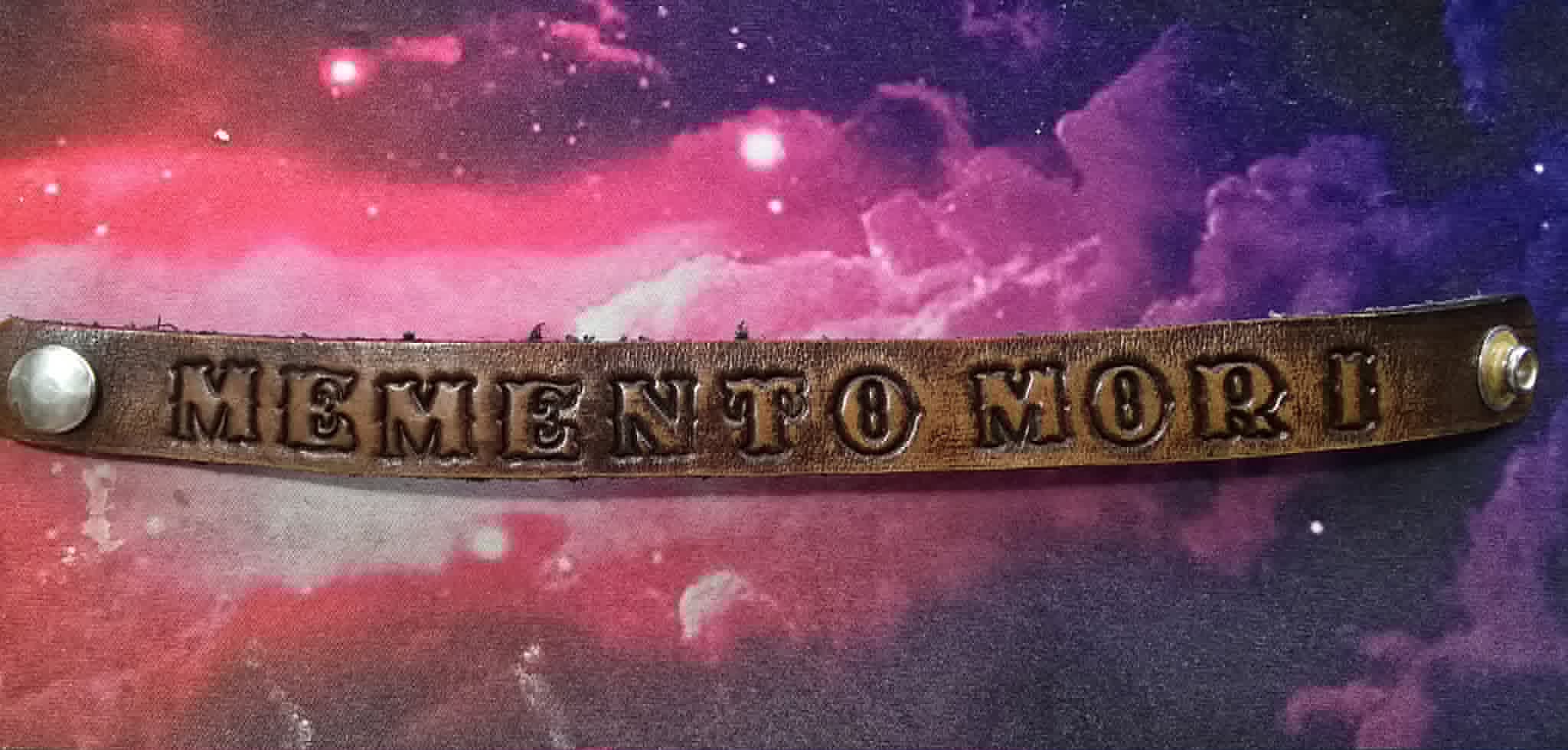
Since I have started wearing it, people have ask me what it says and means and when I tell them it means “remember death” generally their first comment is, “that is morbid”
For many the subject of death may be a morbid and undesirable topic to discuss in this modern age. The one thing that I have learned from the Stoics on their world view of death is, that death is a natural process of the life experience, as one is born one dies, thus death shouldn’t be feared.
From the bible and from the wisdom of the nations we learn that an important part of life is to remember that we all have a completion date and the date of completion is hidden from us.
The purpose and reason for living by the principle of Memento Mori is to help us live a more meaningful life.
Not only does my bracelet remind me to continually to meditate on my own death, I get to share with others the importance of taking time to remember that we all that life is short, we all have an end date.
Clearly, we observe that, throughout man’s journey upon the earth, the masters of wisdom have left us with a wealth of wise counsel concerning how important it is for us be constantly aware of the our mortality.
Thus, I conclude with my favorite life guiding quote from Marcus Aurelius on Memento Mori.
You could leave life right now, let that determine what you do, say, and think.
Terry W. Hayes
6/26
Photo credits:
Memento Mori – AI generated
Bracelet – Mine


Excellent!! Thank you so much, Terry.
Sue Gore (from Florida)